



Ontario growers warn new US duty could drive American buyers to alternative flower suppliers
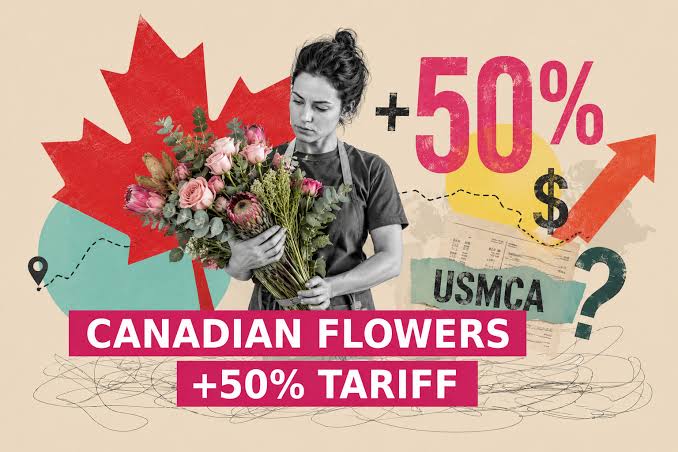
Canada’s cut-flower industry is facing growing uncertainty after the United States imposed a 50% tariff on cut flowers shipped from Canada, raising concerns over the future of a trade relationship that has supported growers and flower businesses on both sides of the border for decades.
John Overbeek, President of Floral Express, said the tariff represents a major challenge for Canadian flower exporters, warning that the additional cost could make it increasingly difficult for Canadian-grown flowers to compete in the US market.“A 50% tariff is simply not sustainable,” Overbeek said. He warned that while American customers may absorb some of the additional cost in the short term, continued exposure to the tariff could eventually force buyers to look elsewhere. That could reduce the number of Canadian-grown stems entering the US market and put pressure on growers, wholesalers, florists and retailers across the Canadian floral value chain.

Ontario farms heavily exposed
Ontario is home to a significant cut-flower industry, with many growers relying on the US as an important export market. Overbeek said a large share of flowers produced in Ontario is shipped south, with some farms having supplied the market for generations. Many of these businesses have invested for decades in greenhouses, production infrastructure, technical expertise and relationships with American buyers.
Some farms have been producing flowers for 20, 30, 50 and even 70 years, highlighting the depth of the industry’s investment and its long-standing links with US customers. Overbeek said Canadian growers have maintained their position in the US market despite competition from domestic American producers and major international suppliers, including South America and the Netherlands. He attributed the continued demand for Canadian flowers to their quality, freshness, consistency and reliability. The new tariff, however, threatens to alter that competitive equation.
Risk of losing US market share
With flowers being highly perishable, exporters have limited room to absorb additional costs without affecting margins or prices. Overbeek said the immediate concern is that American buyers could begin sourcing more flowers from alternative markets if Canadian products become too expensive. “That could mean fewer Canadian-grown stems crossing the border, with serious consequences for growers and the Ontario floriculture sector,” he said.
The industry is now hoping that the tariff will be temporary and that Canada and the US can reach an agreement that restores normal trade. Canadian flower businesses have operated within the framework of CUSMA, which has supported cross-border trade between the two countries. Overbeek said the industry wants to see a resolution that allows Canadian growers to continue supplying their established American customers.
Industry urges unity
Despite the uncertainty, Overbeek has urged growers and other players in the floral industry not to lose confidence. He said the sector has survived previous challenges by adapting, innovating and finding new solutions. “We have faced challenges before. We adapt. We innovate. We find solutions. We keep moving forward,” he said.
He acknowledged that the industry does not yet know how many Canadian-grown stems will continue moving into the US market under the new tariff regime. However, he remains optimistic that the experience could ultimately strengthen the sector. “I do believe that one day we will look back on this period and say, ‘We went through that too — and we came out stronger,’” he said.
A cross-border industry
Overbeek also stressed that the impact of the tariff extends beyond exporters. The North American floral industry is interconnected, with growers, wholesalers, florists, retailers and consumers depending on efficient movement of flowers across borders. He called on Canadian growers and industry stakeholders to support one another, regardless of whether they export to the US or focus exclusively on the domestic market. “What affects one part of our industry affects all of us,” he said.
He also reassured American customers that Canadian growers value the relationships built over decades and remain committed to serving the US market. “To our American friends and customers: we value you, we appreciate the relationships we have built over decades, and we hope that this chapter will be short,” Overbeek said. For Ontario’s flower growers, the immediate priority is finding a way to protect their access to the US market while maintaining the competitiveness of Canadian-grown flowers.
The outcome of the trade dispute could have implications not only for Canadian exporters but also for the broader North American floriculture supply chain. For now, growers are watching developments closely, hoping that negotiations between the two countries will provide a pathway back to normal trade.