

Genebanks and global research deliver climate-smart potato innovations for smallholder farmers worldwide
Lima, Peru, November 5, 2025 — The same disease that triggered the historic Irish Potato Famine continues to threaten global food security, causing up to USD 10 billion in annual losses. With climate change pushing late blight higher into the Andes and other vulnerable regions, farmers face increasing pressure to adapt. But a new, climate-resilient potato variety, CIP-Asiryq, is now giving hope to millions.
Developed by scientists from the International Potato Center (CIP) in partnership with Indigenous communities, CIP-Asiryq is resistant to late blight and requires fewer fungicide sprays — reducing costs, improving yields, and cutting chemical use. The variety cooks 25% faster than Peru’s popular Yungay and is suitable for both table use and processing markets.
“The new resistant variety gives potato farmers an option that can reduce losses, cut costs and strengthen food security,” said Dr. Stefan Schmitz, Executive Director of the Crop Trust. “It’s good news for everyone who loves potatoes.”
Rooted in Climate Collaboration
CIP-Asiryq (pronounced asir-eek) was bred using Solanum cajamarquense, a wild potato relative conserved in the CIP Genebank in Lima, home to the world’s largest collection of potato diversity. The variety’s development was made possible through the Crop Wild Relatives and Biodiversity for Opportunities, Livelihoods and Development (BOLD) projects, led by the Crop Trust and funded by the Government of Norway.
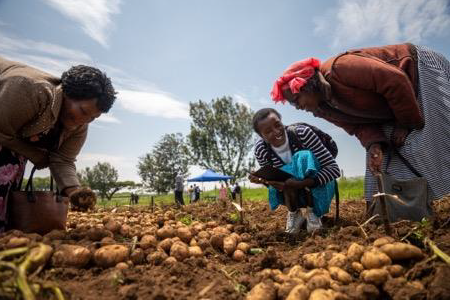
Potato farmers in Njoro, Kenya, rate and discuss new breeding lines as part of the Crop Trust’s BOLD project (October 2025).1
“This is a major step forward for food systems – in the Andes and beyond,” said Dr. Thiago Mendes, CIP scientist and leader of the BOLD Potato Pre-Breeding Project. “CIP-Asiryq’s versatility makes it valuable for both fresh consumption and industrial processing.”
Reducing Fungicide Use and Boosting Income
Late blight can destroy 50–100% of potato yields in some Peruvian regions. To protect their crops, farmers often spray fungicides up to six times per month, spending up to 25% of total production value on chemicals.
CIP-Asiryq’s built-in resistance allows farmers to reduce pesticide use, improve profit margins, and protect their health and the environment. Its processing quality also opens access to high-value markets, such as potato chips and crisps.
“Small-scale farmers will earn more by selling to processing companies, while still serving the fresh market,” said Raul Ccanto from the Yanapai Group, a key partner in the project.
From Peru to Kenya: A Global Impact
CIP-Asiryq’s genetic traits are already being used to breed late blight-resistant potatoes for East Africa, including Kenya, through the BOLD Project. This initiative extends the impact of global crop diversity, linking farmers, breeders, and policymakers across continents.
“This variety shows how genebanks, science, and community knowledge can deliver climate solutions,” said Dr. Benjamin Kilian, BOLD Project Coordinator at the Crop Trust.
CIP-Asiryq now joins a growing list of climate-smart crops under BOLD — including alfalfa in Kazakhstan, durum wheat in Morocco, and rice in Vietnam — proving that genetic diversity is a powerful weapon against climate change.
Why It Matters
- 🌱 Climate resilience: Withstands late blight and unpredictable weather.
- 💰 Economic benefit: Reduces chemical costs and boosts income.
- 🍽️ Food security: Strong yields for table and processing markets.
- 🌍 Global collaboration: Shared through international treaties for breeding use worldwide.
Potatoes & Late Blight
- Potatoes feed 1.3 billion people globally, providing 17% of the world’s food crop calories.
- They are rich in carbohydrates, fiber, potassium and vitamins C and B6.
- In the Andes, warming of 1°C since 1990 has extended upward the altitude range of late blight by 500 meters.
- In the Peruvian city of Huancavelica, farmers spend around $200/ha (approximately 30% of their income) on fungicide sprays to combat late blight.
About the Crop Trust
The Crop Trust is an international organization working to conserve crop diversity and safeguard global food and nutrition security. At its core is an endowment fund dedicated to guaranteeing long-term support to key genebanks worldwide. The Crop Trust supports the Svalbard Global Seed Vault and coordinates major projects worldwide. It is recognized as an essential element of the funding strategy of the International Treaty on Plant Genetic Resources for Food and Agriculture. More at www.croptrust.org
About BOLD
BOLD (Biodiversity for Opportunities, Livelihoods, and Development) is a 10-year project to strengthen food and nutrition security worldwide by supporting the conservation and use of crop diversity. Led by the Crop Trust, in partnership with the Norwegian University of Life Sciences and the International Treaty, and funded by the Norwegian Government, BOLD builds on the decade-long Crop Wild Relatives Project (2011–2021). More at https://bold.croptrust.org
About the International Potato Center (CIP)
Founded in 1971 and headquartered in Lima, Peru, CIP is a research-for-development organization dedicated to improving food and nutrition security, increasing farmer incomes, and supporting climate-resilient agriculture through potato and root crop innovations. CIP has worked in India since 1975 and collaborates closely with national and regional partners across Asia and Africa. More at: https://cipotato.org/
About the Yanapai Group
The Yanapai Group is an association of transdisciplinary researchers with experience in participatory action research processes, which works jointly with peasant communities and organizations of small Andean producers and in collaboration with research centers. More at: https://yanapai.org/