

Kenya’s agriculture sector is on the brink of a structural reset — one anchored on private capital, youth innovation, data-driven transformation, smart technologies and artificial intelligence.
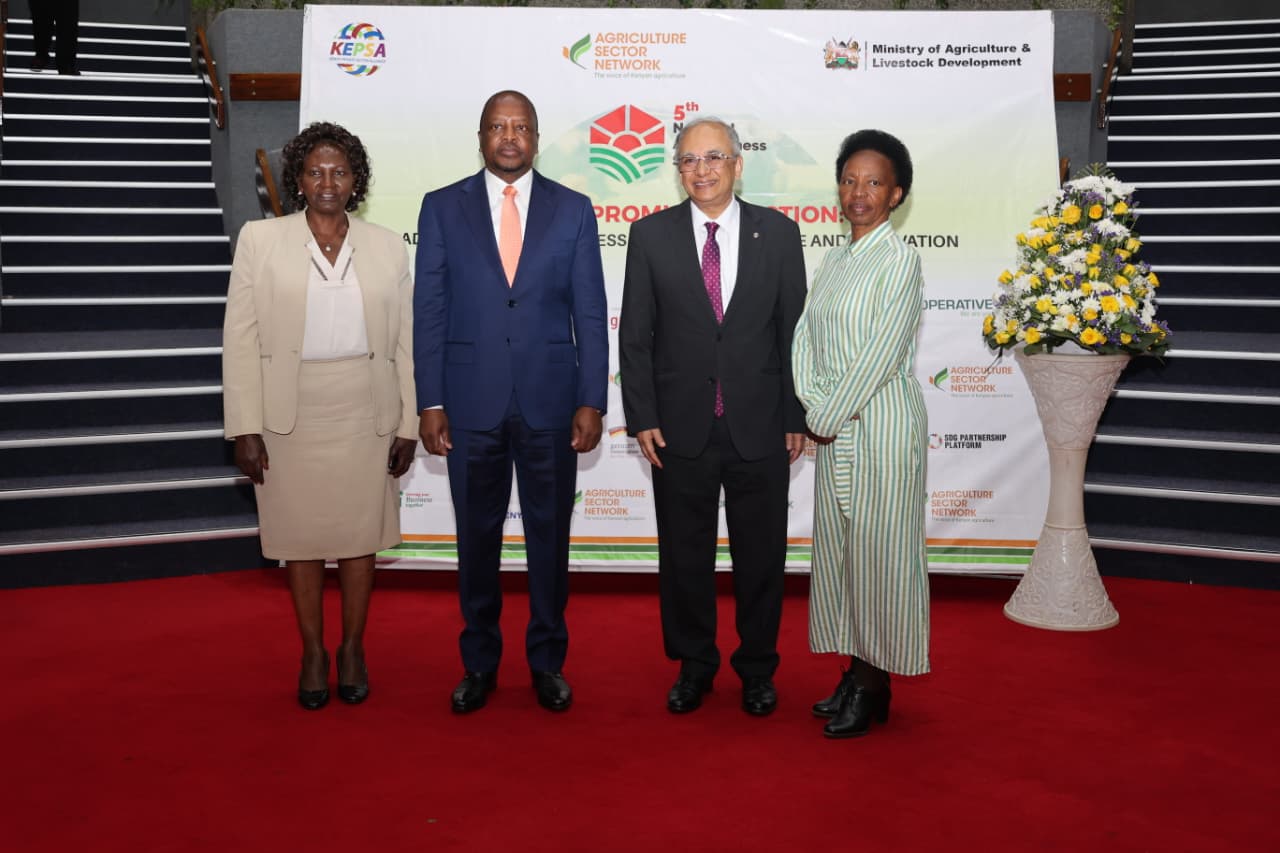
Speaking at the 5th National Agribusiness Summit (NAS 2025) in Nairobi, Agriculture Cabinet Secretary Mutahi Kagwe announced that the government will open up more than 1.5 million acres of land for private investment in large-scale farming, in a move designed to boost food security, create jobs, and cut Kenya’s Sh500 billion annual food import bill.
“This sector is largely driven by the private sector, and we will continue to rely on them to grow agricultural businesses, provide food security, and create jobs,” said Kagwe. “It is the private sector that will provide the backbone we are looking for.”
Kagwe said the government is prioritizing strategic value chains such as rice, wheat, edible oils, and pyrethrum, while also preparing idle land under the Agricultural Development Corporation (ADC) and prison farms for commercialization. Counties including Homa Bay and Migori are already seeking investors to develop palm oil plantations.
He also cited the privatization of the sugar and pyrethrum industries as deliberate policy shifts meant to enhance efficiency and profitability.
“We are moving sugar and pyrethrum from government management to private sector management. This is not by mistake — it is policy,” he stated.
Agriculture Sector Network ( Asnet) Chairman and Elgon Kenya Managing Director Bimal Kantaria welcomed the plan, saying Kenya faces shortage of large tracts of private agricultural land therefore allowing private sector to invest in public land would unlock massive production potential. Dr Kantaria added agriculture is increasingly adopting smart technologies and AI requiring investment in the segment to attract the youth in agribusiness.
In addition, Dr Kantaria urged the government to extend the fertilizer subsidy programme to include biostimulants to give farmers more choices for enhancing soil fertility.
The announcement capped off a high-energy Day 1 at NAS 2025, themed “Transforming Food Systems through Private-Sector Investment and Public Partnerships.” The forum brought together agribusiness leaders, financiers, county governments, development partners, and youth innovators — all echoing one point: Kenya’s next agricultural revolution will be private-sector powered, youth-driven, and technology-enabled.
Day 2 shifted focus to the human engine of agricultural transformation — the workforce.
Opening the session on “Building a skilled, innovative and entrepreneurial workforce for Africa’s agricultural transformation,” Dr. Wilson Songa, ASNET Director, challenged leaders to turn rhetoric into resources.
He lauded ASNET and its partners for creating a credible platform shaping Kenya’s agri-transformation agenda, but warned that the continent’s youth cannot innovate in policy vacuums.
“Africa’s youth are natural innovators — from mobile-based advisory services to AI-driven crop diagnosis — but they need stronger investment and mentorship to turn creativity into enterprise,” Songa emphasized.
He called for deeper alignment between government, academia, and the private sector to build pipelines for talent, innovation, and entrepreneurship in agriculture.
Adding to this, Dr. Jacobi of GIZ Kenya reaffirmed the organization’s commitment to supporting Kenya’s agriculture sector through innovation, inclusion, and sustainability. She highlighted that NAS 2025 is more than an annual gathering — it’s a co-creation platform for translating dialogue into action and partnerships into measurable results.
“The summit gives us the space to collaborate and shape an agriculture sector that is inclusive, competitive, and future-ready,” she noted.
Beyond the Summit: From Policy Talk to Field Impact
Industry players used the two-day summit to push for stronger investment incentives, predictable policy frameworks, and better financing for agri-SMEs. The consensus was clear: Kenya’s agricultural future will be determined not by more policies, but by execution and accountability.
From Kagwe’s bold land-release announcement to Songa’s youth-first challenge, NAS 2025 left no doubt that Kenya’s agribusiness transformation is shifting from talk to traction.
And with over a million acres of opportunity and a generation of innovators ready to reimagine farming, the groundwork for a new agri-economy is finally taking shape.