

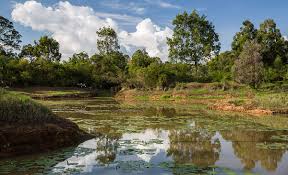

When the railway arrived in the late 19th century, Nairobi was little more than a swamp. The twin “water towers” of Ngong and Karura Forest fed rivers into the Nairobi basin, replenishing aquifers that sustained the Athi and Kapiti plains.
Archaeological findings show Karura was once home to the Ogiek, the Maasai, and later the Kikuyu, who considered the forest sacred and held cultural ceremonies in its caves. In 1901, the colonial government recognized its significance and declared it protected land.
Today, Karura Forest is the largest urban forest within a city in the world, covering 1,063 hectares north of Nairobi’s CBD. It borders Muthaiga, Gigiri, Runda, Ridgeways, Mathare North, Peponi, and New Muthaiga, with the western section known as Sigiria Forest.
Karura is Nairobi’s green lung — an important carbon sink and a biodiversity hotspot. Visitors can spot monkeys, bushbuck, porcupines, dik-diks, civets, and over 200 bird species. Indigenous trees such as African olive, Croton megalocarpus, and Warburgia ugandensis thrive here. Today, Karura offers cycling and walking trails, a waterfall, Amani Gardens for picnics, River Café, and a children’s education centre — making it a favourite weekend destination.
From Threat to Triumph
Karura’s history has not been without struggle. Gazetted in 1932 to supply wood fuel for Kenya-Uganda Railway steam engines, the forest was later planted with exotic eucalyptus. During the 1950s Mau Mau uprising, insurgents reportedly used Karura’s caves as hideouts.
The biggest threat came in the 1990s when 564 hectares were secretly allocated to private developers. Bulldozers moved in by 1998, sparking fierce protests led by the late Nobel Laureate Prof. Wangari Maathai. Despite brutal crackdowns, the protests gained international attention, with UNEP threatening to move its headquarters if Karura was destroyed.
The campaigns culminated in the Forest Act of 2005, which made it harder to degazette forests. Many developers surrendered their claims, marking a turning point for Karura’s future.
A Model for Urban Conservation
In 2009, local residents formed Friends of Karura Forest (FKF) and partnered with the Kenya Forest Service (KFS) to co-manage the forest. FKF raised funds for an electric fence, completed in 2010, which made the forest secure and open to the public.
Since then, Karura has been transformed from a crime hotspot into one of Nairobi’s safest green spaces. By 2015, it attracted over 600,000 visitors annually, generating revenue to sustain operations, employ over 70 staff, and support community education programs.
A Lesson for All
Karura is proof that conservation works when citizens take ownership. It is not just a forest — it is a living reminder of courage, resilience, and the power of collective action.
As Kenya continues to battle land grabs and environmental degradation, Karura stands tall, reminding us that safeguarding natural resources requires persistence, unity, and action beyond rhetoric.