

“Forget AGI. A more profound existential crisis looms around the corner, and we’re hurtling towards its watershed moment. As we exterminate the vast ecosystems that support our very existence, their desperate pleas from beneath our feet, are relent- lessly drowned out by our loud ambitions for bigger, better, faster. Will we finally lend an ear before their silence lingers forever?”
Largely unseen and silent, a miraculous force of nature beneath our feet dictates the terms of our survival. It supplies our food, nurtures our forests, stores our water, and cushions the very climate we depend on. Yet, this crucial resource is rapidly vanishing.
As you read this, every time you blink, the world loses an entire football field’s worth of arable soil. Let that sink in: while nature takes thousands of years to create an inch of fertile topsoil, current farming techniques have been degrading it with frighten- ing swiftness. Experts predict that by 2050, nearly 90% of Earth’s soils could be degraded, losing their vitality, structure, and life. We are literally losing the living skin of our planet.
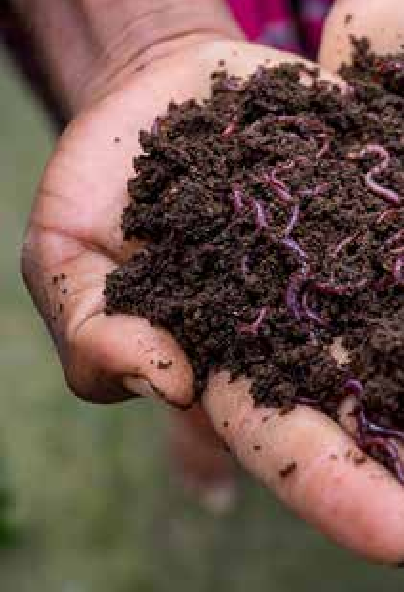
Charles Darwin hailed earth- worms as Earth’s most important lifeform, dubbing them “nature’s plough” for their unparalleled role in cultivating the planet. He understood that beneath the sur- face lies a dynamic world, more valuable than all the precious metals it contains, and irreplace- able within a human lifespan.
From Barren Rock to Thriving Earth
Picture a lifeless rock. Over time, lichens begin to colonize it, followed by mosses, grasses, shrubs, and eventually trees. This is how soil forms—not through machinery or artificial inputs, but through the power of life itself. With the compelling analogy of a three-legged stool, Joel Williams illustrates how the vital trinity of physical, chemical, and biological forces culminates in a powerful acapella, proclaiming, “Let there be soil.”
This transformation from inert rock to rich soil occurs through a symbiotic relationship between plants and microbes. Through photosynthesis, plants capture sunlight, water, and carbon dioxide to create sugars—liquid carbon—which they then exude into the soil through their root systems. The exudates feed a complex microbial world that scientists are still working to fully understand.
“Soil without biology,” explains soil health expert, Joel Williams, “is just geology.” In essence, dirt becomes living soil only when it teems with life, and this life,in turn, relies on the resources provided by plant roots.
The Secret Exchange That Feeds the World
In the depths of Earth’s embrace, where roots weave through the soil, an age-old economy flour ishes. Its trade is not in tangible goods but in the liquid carbon that plants offer to the soil. These are no mere secretions; they are the currency of life itself, drawing microbes into a contract older than agriculture.
Drawn by the rich bounty of car bohydrates and proteins (in the form of root exudates), fungi and bacteria gather around the roots. In return for their feast, they repay the plants in kind: Soil without biology, is just geology—explains soil health expert, Joel Williams
• Nitrogen, phosphorus, potas sium—vital nutrients for growth, pried from the grasp of unyield ing earth. • Antibiotics and enzymes standing guard against blight and rot.
• Glomalin, a sticky fungal se cretion that binds soil into crum bling, breathable aggregates.
• Carbon sequestration—lock ing away carbon as rich, endur ing humus.
Yet we disrupt this delicate ecosystem with every turn of the plough, poison it with every heedless spray, and ignore it in policies that treat soil as inert dirt. The ultimate tragedy is not just the loss, but our fundamen tal failure to recognize what we have… until it is utterly gone.
British singer Passenger’s 2012 hit ballad ‘Let Her Go’ wraps a universal human weakness in a few deceptively simple lyrics: “Only need the light when it’s burning low, only miss the sun when it starts to snow…” By the time we quantify the full ecologi cal cost of soil degradation, the biological systems it supports may already have collapsed.
For too long, the narrative of agricultural improvement has focused on what we
add to the soil—the synthetic boost, the quick chemical fix. But the land, seconded
by numbers, is speaking a different language: one of compacted earth, depleted life,
and a growing aloofness to conventional remedies.
Kenya’s Growing Crisis: When More Isn’t Enough
Across Kenya, farmers face a stark reality: despite efforts to boost yields with fertilizers, the expected gains have trailed be hind. Studies between 1992 and 2013 revealed that while fertilizer application rates increased from 82 kg/ha to 100 kg/ha during this period, maize yields either stagnated or even slightly de creased from 1360 kg/ha to 1116 kg/ha. This disconnect highlights a deeper issue beyond simple in put use. For too long, the narra tive of agricultural improvement has focused on what we add to the soil—the synthetic boost, the quick chemical fix. But the land, seconded by numbers, is speak ing a different language: one of compacted earth, depleted life, and a growing aloofness to con ventional remedies.
Kenyan farmers possess the power to revitalize their land through a conscious return to natural principles. By actively establishing cover crops post harvest, they can nourish the soil’s unseen microbial work force—bacteria, fungi, arthro pods—below. Choosing minimal soil disturbance allows intricate underground networks to flour ish, enhancing fertility. Intention ally diversifying crop systems cultivates a vibrant and sup portive soil ecosystem. Further more, the strategic integration of livestock grazing can mimic nature’s cycles to aerate and en rich the land. These fundamental shifts promise a powerful syn ergy, yielding not only improved harvests and healthier soils but also vital resilience against the devastating extremes of flood and drought.
The Call from Beneath Our Feet
We are at a critical inflection point—where soil degradation, climate variability, and pest resistance converge to under mine agricultural resilience. Truly addressing this demands a paradigm shift: moving beyond simply feeding crops to actively rebuilding the intricate biological networks beneath them.
Bioline AgroSciences (and the biological pest control industry at large) recognizes this fundamental need, offering a suite of biological solutions designed to work in harmony with soil eco- systems:
- Mytech® WP: A potent nema- ticide harnessing Paecilomyces lilacinus that targets a spectrum of damaging nematodes, includ- ing root-knot, cyst, lesion, bur- rowing, and reniform varieties.
- Trichotech: Based on the antagonistic fungi Trichoderma asperellum, which establishes a protective presence against soil- borne pathogens.
- Nemguard: A garlic-extract nematicide that provides an- other natural defense against plant-parasitic nematodes.
- Entomopathogenic Nema- todes: A range of beneficial nematodes offering targeted pest control.
These innovative inputs don’t sterilize the soil; instead, they restore vital microbial balance, enhance natural nutrient cycling, and fortify plant defenses from their roots upwards, effectively reawakening the soil’s inherent capacity to support life.
By embracing this alignmentwith soil biology, we transitionfrom a model of forceful control to one of fruitful collaboration, prioritizing long-term resilienceover short-term yield gains. We do more than farm. We regenerate. This is because, in the fundamental language of the
soil, life doesn’t just survive — it multiplies