

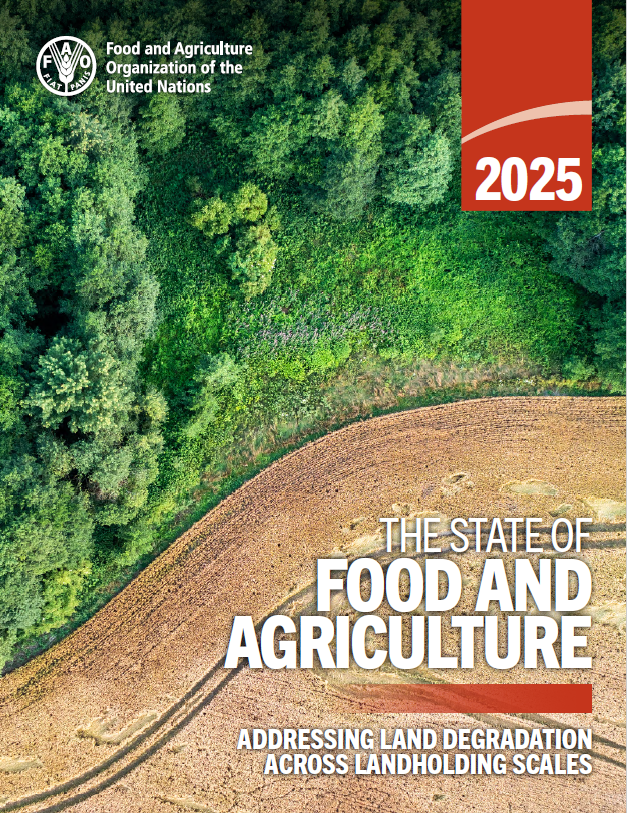
Rome, Italy – The Food and Agriculture Organization (FAO) of the United Nations has sounded the alarm in its State of Food and Agriculture 2025 report, warning that human-induced land degradation has become one of the world’s most pressing yet under-acknowledged threats to food production, livelihoods, and the environment.
The report, titled Addressing Land Degradation Across Landholding Scales, paints a stark picture: over 1.7 billion people live in areas where land degradation is already undermining food yields. The degradation is spreading fast across all continents, eroding soil fertility, triggering land abandonment, and worsening poverty in rural communities — especially in sub-Saharan Africa and South Asia.
“The land that has sustained humanity for millennia is under severe stress,” FAO Director-General Qu Dongyu said. “Agriculture must evolve from a driver of degradation into a source of restoration — delivering better production, better nutrition, a better environment, and a better life for all.”
The Scale of the Crisis
The FAO notes that agricultural expansion remains the leading cause of global deforestation, responsible for nearly 90 percent of total forest loss between 2001 and 2023. In sub-Saharan Africa alone, 69 million hectares of new cropland emerged at the expense of 72 million hectares of forest.
Globally, the total agricultural area shrank by 75 million hectares in the last two decades, but cropland increased — replacing forests, grasslands, and wetlands. This “cropland expansion paradox” shows that humanity is not gaining new fertile land, but merely degrading what already exists.
Between 3 and 4 million hectares of farmland are abandoned each year, often due to exhaustion of soil nutrients and declining profitability. Meanwhile, nearly 500 million smallholder farmers, who cultivate just 9 percent of the world’s farmland, are carrying the heaviest burden of land degradation and climate shocks.
Unequal Land Distribution and Productivity Gaps
FAO’s new global database on farm size and land distribution reveals deep inequality in how the world’s agricultural land is managed:
85 percent of farms worldwide are smaller than 2 hectares, yet control only 9 percent of farmland.
- The 0.1 percent of farms larger than 1,000 hectares operate nearly half of all agricultural land.
- Medium-sized farms (2–50 ha) are critical in Africa and Asia, managing around half of all farmland.
This unequal structure influences productivity and resilience. Large farms dominate global commodity trade, while smallholders remain central to local food systems and dietary diversity.
Despite their limited land, smallholders contribute 16 percent of global calories, 12 percent of protein, and 9 percent of fat derived from crops — and up to 50 percent of spices, fruits, and stimulants. Yet their potential is constrained by poor soil fertility, insecure land tenure, and limited access to credit, technology, and markets.
“Africa’s smallholder farmers are caught in a double poverty trap,” the report notes. “They cannot produce enough to invest in soil restoration, and without restoration, their productivity continues to decline.”
Land Degradation and Climate Change: A Dangerous Feedback Loop
The report warns that climate change is intensifying the cycle of degradation. Extreme heat, drought, and floods accelerate soil erosion and carbon loss, pushing fragile lands beyond recovery. Under warming scenarios, smallholders in tropical regions face the highest exposure to weather extremes — threatening already fragile food systems.
FAO estimates that reversing just 10 percent of human-induced land degradation could restore enough productivity to feed an additional 154 million people every year. Restoring abandoned croplands could feed up to 476 million people, underscoring that regeneration is both possible and profitable if done systematically.
However, the agency warns that inaction will have irreversible consequences: degraded soils reduce carbon storage, worsen biodiversity loss, and weaken the world’s resilience to climate change.
Policy Solutions: From Degradation to Regeneration
FAO calls for “scale-sensitive policies” that reflect the diversity of land users — from smallholders to large commercial farms. A one-size-fits-all approach, the report argues, will fail.
1. Strengthen Land Tenure and Rights
Secure land tenure is the foundation of sustainable land management. Farmers who own or have long-term rights to their land are more likely to invest in soil conservation, water harvesting, and reforestation. Yet gender inequality persists: in 43 of 49 countries analyzed, women are less likely than men to hold secure rights to agricultural land. Empowering women could significantly increase soil conservation and crop diversity.
2. Combine Regulation with Incentives
Land degradation cannot be solved by regulation alone. FAO recommends blending regulatory, incentive-based, and cross-compliance mechanisms:
- Regulations (such as deforestation bans or soil conservation laws) set the framework.
- Incentives, including payments for ecosystem services, reward farmers who adopt sustainable practices.
- Cross-compliance schemes link government subsidies to environmental standards — ensuring public funds support stewardship.
This policy mix, FAO notes, delivers the strongest results when tailored to local land cover types and socioeconomic realities.
3. Support Restoration Hierarchies: Avoid > Reduce > Reverse
Not all lands need the same intervention. The UNCCD’s land degradation neutrality (LDN) hierarchy — avoid, reduce, reverse — is endorsed as the most cost-effective framework. Healthy lands must be protected first, degraded lands rehabilitated next, and severely damaged areas restored through reforestation, agroforestry, or long-term fallowing.
Regional Focus: Sub-Saharan Africa and Asia as Hotspots
Sub-Saharan Africa and South Asia emerge as vulnerability hotspots where degraded lands, poverty, and malnutrition overlap. FAO estimates that 47 million children under five suffering from stunting live in areas severely affected by land degradation.
The organization urges governments to integrate land restoration into national food security, climate, and rural development plans — arguing that every dollar invested in land restoration can yield up to ten dollars in economic benefits through improved yields, ecosystem services, and resilience.
FAO’s Director-General concluded the report with a call for decisive, collective action:“We must care for the land that feeds us. Secure tenure, inclusive governance, and sustainable practices are not optional — they are our only path to a food-secure and climate-resilient future.”
The report challenges governments, development partners, and agribusiness leaders to align economic incentives with ecological responsibility, transforming agriculture from an extractive system into a regenerative force.