

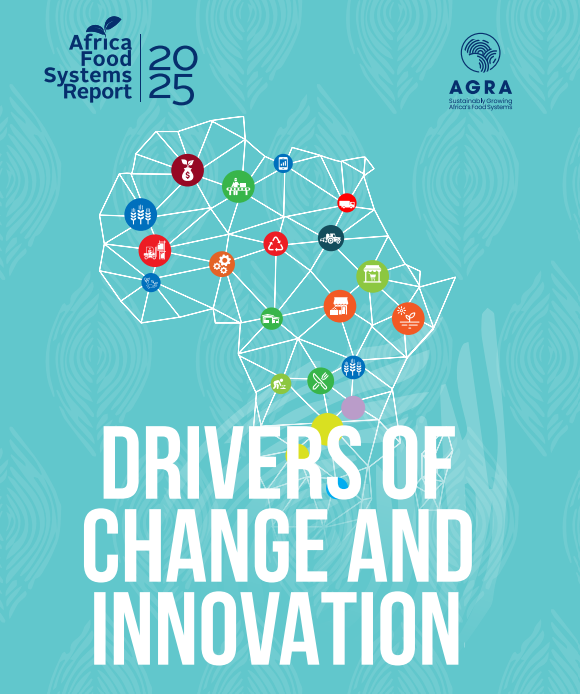
New continental report charts pathway from isolated progress to integrated, resilient agrifood systems
Africa’s agriculture sector has grown faster than any other region since 2000, yet one in three children remains stunted and the number of undernourished people continues to rise. This stark contradiction lies at the heart of a comprehensive new analysis calling for a fundamental shift in how the continent approaches food security.
The Africa Food Systems Report 2025, released by the Alliance for a Green Revolution in Africa (AGRA), reveals that while agricultural output has expanded at 4.3% annually over the past two decades, these gains have been fragmented across regions and disconnected from broader nutrition and sustainability outcomes.
The Missing Link: From Production to Nutrition
“Progress is evident but uneven,” the report states, noting that extreme poverty has declined from 58% to 35% since the 1990s and life expectancy has increased by over 14 years. However, productivity growth has not translated into food security—a disconnect that exposes fundamental weaknesses in how food systems operate.
The Prevalence of Undernourishment, which had fallen to 15% by 2015, climbed back above 19% by 2022, driven by conflict, climate shocks, and the COVID-19 pandemic. This reversal has pushed Africa further off track from achieving Sustainable Development Goal 2: Zero Hunger.
A Systems Approach to Transformation
The report introduces a new framework centered on food baskets and corridors—strategic production zones linked through improved infrastructure, market systems, and policy alignment. These spatial approaches are designed to connect surplus-producing regions with deficit areas while strengthening regional value chains.
“The concept emerged to enhance food security by leveraging Africa’s agroecological diversity,” the report explains. Major food baskets span the Nile River Delta, the Niger and Volta Basin, the Lake Malawi/Lake Tanganyika Basin, and the Limpopo River Basin, among others.
However, infrastructure deficits remain severe. Only 6% of Africa’s cultivated land is irrigated, compared to a global average of 20%. Post-harvest losses reach 30-40% for many crops due to inadequate storage and cold chain facilities. Transport costs are up to 60% higher than global averages, constraining market integration.
The Finance Gap
The report identifies financing as the central bottleneck, with Africa facing an annual infrastructure gap of $67-108 billion. Agriculture receives less than 5% of commercial bank lending, while traditional donor assistance is declining.
“Mobilizing USD 100 billion in agrifood investments by 2035 will require consistent implementation, stronger institutional capacity, and coordinated, transparent accountability mechanisms,” the report states, referencing commitments made at the 2023 Dakar II Feed Africa Summit.
Innovative financing mechanisms are emerging: blended finance approaches that combine public and private capital, digital credit platforms reaching previously excluded farmers, and climate-aligned investment funds. Yet these remain insufficient without enabling policy reforms and de-risking mechanisms.
Digital Revolution in Agriculture
Digital technologies are reshaping African agriculture, with over 500 agritech startups active by 2022 and investment exceeding $60 million, up from $13 million in 2017. Mobile-based platforms now deliver weather forecasts, market prices, and agronomic advice to millions of farmers.
Solar-powered irrigation systems have emerged as transformative solutions, with costs declining by more than 60% since 2012. Projections suggest that investing just $3 billion annually in solar irrigation could yield over $5 billion in profits, primarily for smallholders.
Governance: The Missing Ingredient
Perhaps most critically, the report identifies governance quality as a decisive factor in food system performance. Countries with effective institutions, transparent policies, and coordinated planning consistently achieve better nutrition outcomes and lower food insecurity.
“Governance quality not only correlates with, but also directly shapes food system outcomes in Africa,” researchers found. Countries like Mauritius and South Africa, with stronger governance scores, demonstrate significantly lower food insecurity rates than nations with weak institutional frameworks.
The Kampala CAADP Declaration, adopted in January 2025, reinforces this message by positioning governance, policy coherence, and mutual accountability as cross-cutting pillars of agricultural transformation.
Five Imperatives for Action
The report concludes with five strategic imperatives:
- Systemic alignment: Institutionalize unified agrifood systems strategies that bridge agriculture, nutrition, health, trade, and environment
- Targeted investment: Deploy blended finance mechanisms to mobilize the $100 billion needed by 2035, with safeguards for marginalized groups
- Strengthened governance: Build implementation capacity, decentralize authority, and harmonize legal frameworks across ministries
- Spatial transformation: Develop food baskets and trade corridors to connect production zones with markets and catalyze value addition
- Next-generation knowledge systems: Create digitally integrated, co-produced data platforms that enable real-time, evidence-based decision-making
Looking Ahead
“The transformation of Africa’s food systems hinges on finance and investment as catalytic levers for change rather than as supportive elements,” the report emphasizes. “The future of Africa’s agricultural transformation depends not just on more data or smarter policies, but on rethinking knowledge as a public, institutional, and political asset.”
With Africa’s population projected to reach 2.5 billion by 2050, the urgency is clear. The continent possesses vast agricultural potential—60% of the world’s uncultivated arable land—but realizing this potential requires moving from fragmented interventions to integrated systems transformation.
The question is no longer whether Africa can feed itself, but whether it has the political will, institutional capacity, and coordinated investment to make that vision a reality.
The Africa Food Systems Report 2025 is available at www.agra.org