

Kenya’s macadamia sector is entering a transformative era—fuelled by visionary leadership, policy reform, strategic infrastructure, and strong farmer participation. As the third–largest exporter globally and the second-largest in Africa, Kenya is reclaiming its rightful place in the high-value nut market.
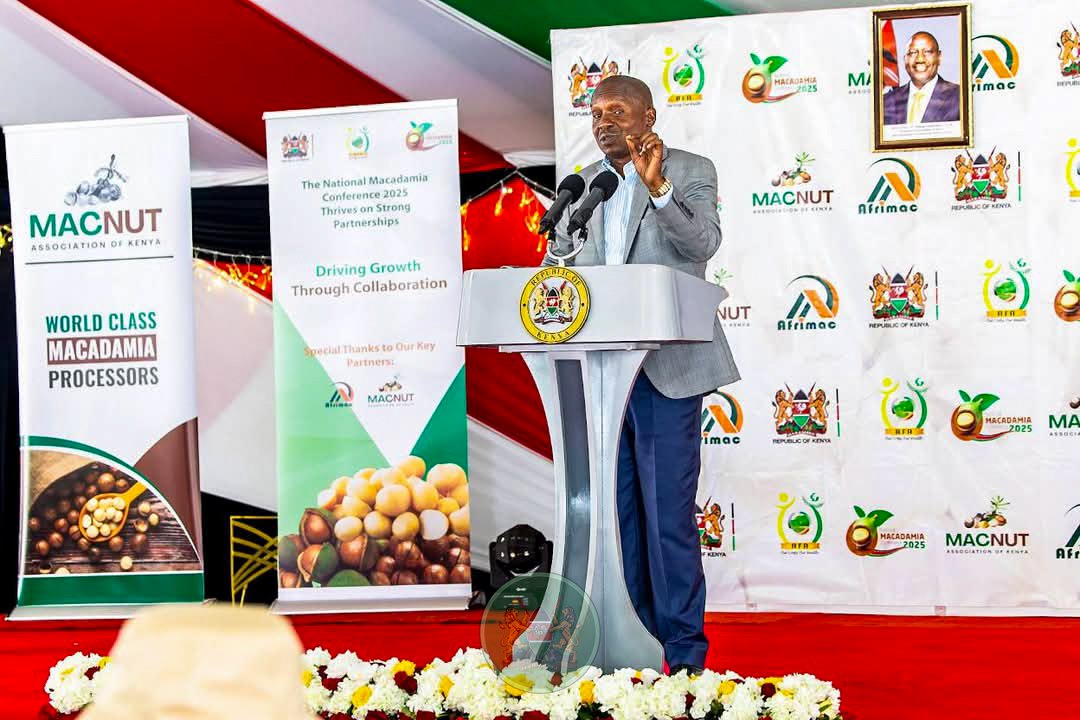
This momentum was clearly evident at the First National Macadamia Conference, held at Embu University, where Deputy President Prof. Kithure Kindiki and Dr. Paul Ronoh, Principal Secretary for Agriculture, joined a wide array of stakeholders to map the industry’s future.
Over 200,000 smallholder farmers are engaged in macadamia production, supported by 40 licensed processors, creating over 30,000 jobs in rural and peri-urban communities. The crop is grown in over 18 counties, including Embu, Meru, Kirinyaga, Murang’a, Nyeri, and Bungoma, making it a vital income generator.
According to 2024 export figures, Kenya produced 15,000+ metric tonnes of macadamia, exporting over 10,200 mt and earning approximately USD 53.7 million. Despite this, only about 40% of the nuts are processed locally, leaving significant untapped value on the table.
landmark initiative that dominated conversations at the conference was the Embu County Aggregation and Industrial Park, located in Machang’a, Mbeere South. This flagship project—part of the national Bottom-Up Economic Transformation Agenda (BETA)—is designed to: elevate local processing capacity, private investment, create market linkages and value chains and open up global export markets.
The park aligns with the government’s broader push to scale up County Industrial Parks across 19 counties, backed by over KSh 4.7 billion in investment.
“We are spearheading targeted interventions to enhance productivity, reduce production costs, and promote value addition to maximize farmers’ earnings,” said Dr. Ronoh.
The government has reinstated a ban on raw macadamia exports, effective June 5, 2025, to safeguard local processors and increase returns to farmers. Exporters caught violating the ban will face penalties under the Crops Act and Horticultural Crops Regulations. Enforcement aims to:Discourage smuggling of unprocessed nuts, Enhance local value addition, Ensure fair pricing and traceability in the value chain
“No raw nuts will be exported. Our goal is to make sure farmers benefit from the full value of their harvest,” said Deputy President Kindiki.
Despite the high quality of Kenya’s macadamias, domestic consumption remains below 5%. However, processors such as Kakuzi PLC are t, railblazing new value-added products like:cold-pressed macadamia oil, macadamia flour and nut butter, roasted snack packs and activated charcoal from nut shells
With the global market expected to grow from USD 1.6 billion in 2024 to USD 1.79 billion in 2025, Kenya’s industry is strategically placed to meet the increasing demand—especially from the U.S., China, and Germany, who collectively import over 60% of global supply.